
Norfolk County’s Artist William E. Cantelon
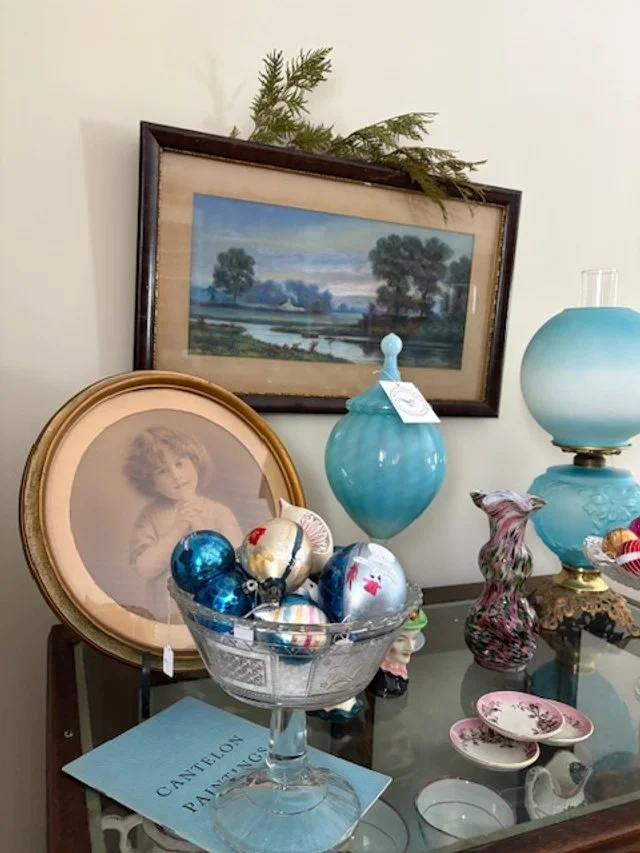
A Cantelon portrait and a landscape in the shop.
William Edgar Cantelon understood that what is here today may be gone tomorrow and nothing escaped his attention. He recognized the value of the every day. He painted portraits – human and animal, flora and fauna, landscapes and historical buildings.
He was tenacious in his need to paint Norfolk County and as a result left a valuable legacy for future generations. It is estimated that he created more than 8,000 paintings, which is pretty impressive especially when you put it into context. Cantelon lived to be 83, which means he would have had to churn out 95 paintings for every year of his life.
William Edgar Cantelon was born 1860 in Peel County and as a young boy grew up on a farm near Streetsville which at that time was located in the Township of Toronto North. He had 4 sisters and 3 brothers. Like most boys of the 1800s Edgar had daily farm chores. He found these to be dull and mundane and tried to complete them as quickly as possible so that he would have more time to pursue his true passion. He loved to sketch and paint.
Cantelon’s parents William and Catherine were supportive and encouraging of their son’s artistic endeavours but for a pioneer family art supplies would have been a real luxury, even if there was availability. His father inspired him with kind and encouraging words and each night when he came in for the evening meal, Cantelon would show his father what he had created during the day. His mother, Catherine, provided him with paper on which to sketch. She saved the white paper wrapped around tea purchased at the general store which she smoothed, folded and stitched together to create books for Edgar’s pencil and colours.
Paper was not the only thing that was difficult to come by. As a member of a growing family, money was scarce even for the most essential items. Cantelon had to rely on his own ingenuity and boyish enthusiasm to provide himself with the necessary equipment. Brushes were a must and for those he looked no further than his backyard. He discovered that the ear hair of their family dog was stiff yet flexible and made perfect bristles. I’m not sure how he discovered this!
A trip to the poultry yard yielded a few feathers. He split the quills, dipped one end of the gathered hair in glue, and inserted them into the quill. He then wrapped it with cord to hold it together. Cantelon is quoted as saying, “Of the hundreds of ‘boughten’ brushes I have used, none has given me more of a thrill as did this childish product...” He craved colour for his sketches. He experimented with berry juice, sumac fruit and wool but found these unsatisfactory. One day while poking at the brick of his house with a pocketknife he noticed that it created red dust. Intrigued, he moistened it with his own saliva and discovered he had a wonderful red ‘paint’.
As a young man, Cantelon had the good fortune to travel to Chicago where he studied art. There, his colleagues nicknamed him “Canada”. Upon returning home, he joined his family who had moved to Norfolk County. He lived with his parents and siblings and later lived with his brother Ernest and his wife in Doan’s Hollow.
Cantelon established a studio on the second floor of 42 Norfolk Street, Simcoe, ON and pursued a career in art. There he painted to earn a living but also gave lessons. He advertised these lessons weekly in the Simcoe Reformer offering both group and private lessons.
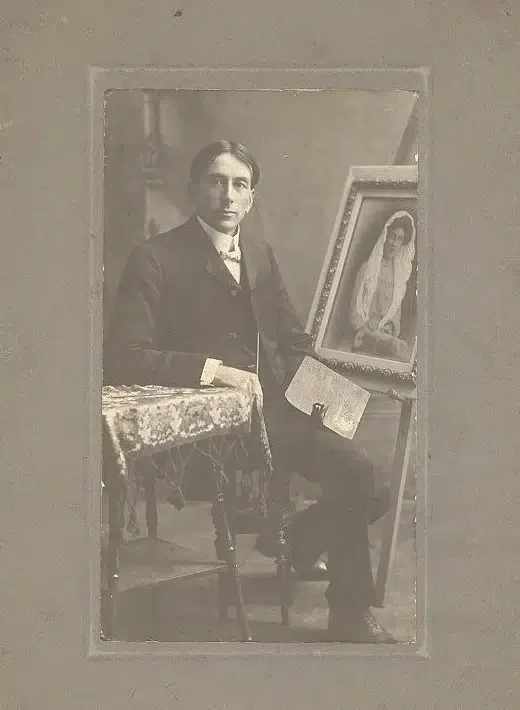
William Edgar Cantelon in his studio.
Dorothy Anderson Riddle took lessons from Cantelon during the 1930s. When I met with her 20 years ago, she reminisced about her time spent with Cantelon whom she described as somewhat eccentric. Lessons took place on Saturday and apparently Cantelon looked upon these as important events. He would sweep his studio and put on a clean shirt each Saturday morning. As he used his studio for a workshop to craft mats for his work and make frames, there was a lot of sawdust. Sweeping entailed pushing it all to one side of the room.
At the time I interviewed Dorothy, she still had her original box of supplies she’d received from Cantelon. Everything was contained in a Stanfield Underwear box. Inside is a beautifully grained palette, two paintbrushes, two tiny tin cups, one for paint and one for turpentine, a flexible knife and a dozen tubes of oil paint. The kit cost each student $4.64. Dorothy remembers Cantelon as “quite a gentleman, I was glad to have known him.”
Dorothy had a special connection to Cantelon. Her family church, Wilsonville United is home to a large 9 x 10 foot Cantelon painting. It depicts a peaceful river with sheep grazing along its banks, willow trees and in the distance a small country church. This painting was commissioned by Dorothy’s father in memory of Dorothy’s mother who died in 1931. When Dorothy was taking lessons, Cantelon was working on the painting so it was in his studio. Dorothy painted some of the leaves as Cantelon insisted that she put a little of herself into the piece.
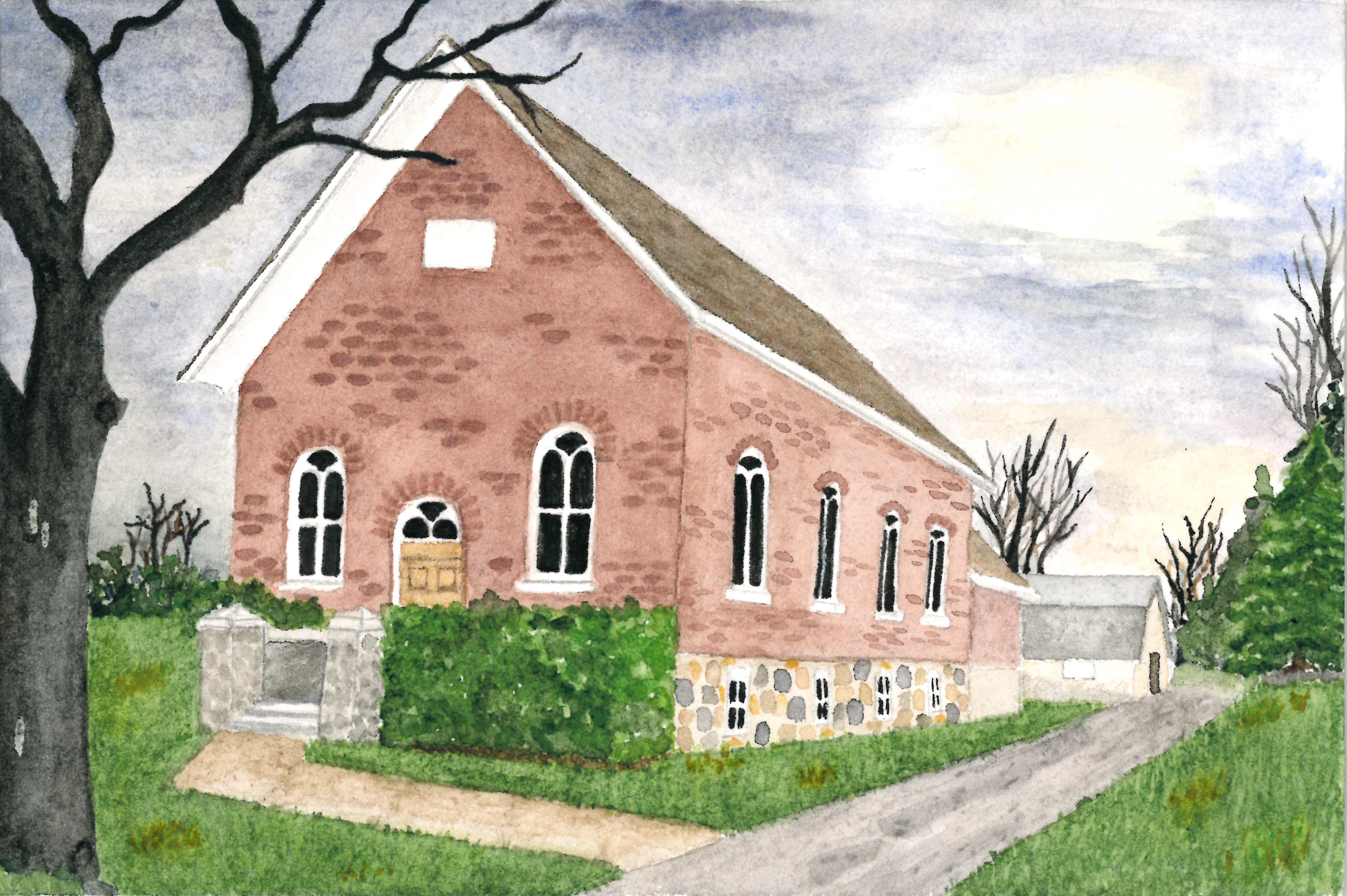
Wilsonville United Church by a local artist.
When he wasn’t giving lessons, Cantelon could be seen riding his bicycle up and down the concessions of Norfolk sketching and painting. During the winter months, he would stay in town on a sofa he had in his studio. During the summer months, he lived in Doan’s Hollow.
As he travelled around the County, he painted places – family burial grounds, churches, flour mills, tanneries and historic homes. He painted people including Abigail Becker and General John Graves Simcoe. Many people commissioned Cantelon to paint portraits of their pets or prized livestock.
Cantelon has always realized the value of documentation. He kept meticulous notes in journals where he recorded all the portraits he painted. One journal documented over 2,000 portraits – the information included the subject’s name, where they live, and how much they paid. In some cases, he wrote down the medium he used. He worked in watercolour, oil, pastel, pencil and charcoal.
He gave talks all over the County, he spoke at every Women’s Institute (WI) meeting in the County. He curated fabulous displays of his artwork at the Norfolk County Fair where he won many prizes. He even exhibited a the Canadian National Exhibition.
In the 1940s, the 300 or so paintings that Cantelon had created of historic Norfolk County, came to the attention of the Ottawa Public Archives. They were very anxious to purchase them. But Cantelon refused to allow them to leave the area even though the sale would have eased his financial burdens. He knew their value beyond a monetary one and he wanted to ensure that they stayed in Norfolk as a legacy to future generations. In the late, 1940s, the Norfolk Historical Society held a fundraising drive. It began in 1945 and by the end of 1947 the community had donated $3,500 with which to purchase the collection. Every WI in Norfolk donated as did local businesses and industries, churches, and many Norfolk County citizens until they were at the $2,000 mark. In order to have the $3,500 required, the Norfolk County Council granted the remaining amount of $1,500.
W. E. Cantelon passed away on March 3, 1950 and is interred at the Woodhouse United Church Cemetery in the family plot. Cantelon was a visionary who dedicated his life to collecting and preserving the history of Norfolk County. He left behind an amazing legacy through his art and it has become highly collectible. Wilsonville Vintage & Antiques feels privileged to offer some of his work in the shop.